Sunday, October 23, 2011

The Last Thing I Remember by Andrew Klavan


This is a young adult book for boys aged 12-15 years. Supposed to be action packed, I must say I was pretty bored with it. Well, I am not a boy and I am not aged 12-15, but still, I enjoy a YA-novel as much as the next person.

The Last Thing I Remember has an awfully good premise: Young Charlie West goes to sleep as a happy and cleancut young man and wakes up strapped to a chair, battered, bloody and bruised. And the last thing he remembers is the happy day at school, his success in karate, his deep love of his country and God.

Now he has no clue why he is being held captured, being tortured and being talked to like he is playing a major part in some warlike game, involving death, terrorism and definitely no love of his country or God. How did this happen to him? Charlie goody-goody West? Charlie who lived a healthy and wonderful and most of all normal teenage life!?

Right. That sounds much more intriguing that it really is. I grew absolutely mega tired of Charlie West. No, I don't need profanity, sex or drugs in my reading. And in fact I enjoy YA novels (or other novels as well) that does not have profanity, sex or drugs in them, and I do not necessarily think that those issues need to be in a good book. But I need som edges and Charlie and this book and the premise was too much. Not enough edge at all. Friends and enemies are laid out way to thick in this one, and it becomes boring to the extreme. It actually felt kind of like I was being indoctrinated.

All that said, during my reading I sort of detected that maybe it was laid on so thick in order to make the reader think a bit. Can you really put up things like that? Is the world really just black or white, depending on the eyes of the beholder? Was this what this book was all about? This did intrigue me, and I gave Charlie another chance in book # 2, The Long Way Home.

Both books are part of Andrew Klavans Homelander-series. I can't say that I was all that impressed, but as you can see, I am not finished with Charlie West yet. And if you read this series, you will also want to find out what on earth happened between the time Charlie went to bed a happy average and good teenageboy and woke up strapped and tortured.

Monday, August 15, 2011

White Trash Cooking by Ernest Matthew Mickler


Food is all around. Not just as something that we need to survive, but also in the form of books, supplements in papers, food blogs, super star chefs, Michelin starred restaurants, tv-programs, different "schools" and movements being the it-trend (like raw food is the big thing in Denmark right now), other movements going back. And os on.


Old news I hear you say, and you are right. Food blogging is so not my thing, as well as I know next to nothing about food anthropology. Nevertheless, I have a great interest in food, cooking, books about food and that kind of unscientific research you can do by just reading cook books from a certain place or period. I would've posted this Sunday and made it a part of Beth Fish's Weekend Cooking, but since I already made two posts this evening, I thought I would post this today insted.

Anyway. When I look at old magazines with recipies, I have to smile sometimes, thinking: can you believe we ate that in the 70'es. And check out the plates they are serving this dish on and the glass they are drinking from. On the other hand, at least in Denmark there are very classical cook books more than a 100 years old still being used and re-printed again and again. I have some of those old cook books myself. But mostly I have books about food in the Ramsey, Nigella and Jamie-category and books with certain culinary themes like Danish food, Thai food, Indian food, Jewish food, Greek, Moroccan, American...well, you get it. I enjoy reading them all as well as cooking a dish or two.

It is not like I cannot pass the cook book section in a book store without having to buy the latest book, because I can easily do that. But on my recent trip to USA I stumbled upon a cook book that I just knew instantly was a must have: White Trash Cooking. It was published for the first time in the 1980'es and is apparently considered a bit of a classic, re-printed several times since the first publication. And yes, it is written tongue in cheek, but it is nevertheless a real cook book with real recipes, and I find it a charming book. It is not just a funny joke on behalf of an unfortunate group of people. Let us have a look at how the author Ernest Matthew Mickler describes white trash in the intro:
[...] But the first thing you've got to understand is that there's white trash and there's White Trash. Manners and pride separate the two. Common white trash has very little in the way of pride, and no manners to speak of, and hardly any respect for anybody or anything. But where I come from in North Florida you never failed to say "yes ma'm" and "no sir" [...] never forgot to say "thank you" for the teeniest favor. That's the way the ones before us were raised and that's the way they raised us in the South.
In this funny and quirky book you will find recipes for fried and broiled squirrel, fried possum, barbecued alligator tail and swamp cabbage stew. But that is not all. You will also find the most delicious recipes on how to cook shrimp, crawfish, crabs and other kind of seafood that you find in abundance in the South plus lots of cakes and sweets.

The book also states that White Trash-food has less fat (but there is still plenty of calories, though) than  Soul Food and many other interesting facts you can read in the very well written intro.

No, I do not think that I would find fried squirrel a particularly delicious thing to eat. And I don't know what to say about the High Calorie Pick Me Up-drink, which is a bag of peanuts put into a cold coke, so that you can drink and eat at the same time.

But Tutti's Fruited Porkettes (pork chops with sweet potatoes, pineapple and bacon baked in the oven) sounds yummy, as well as Klebert's Cold Crawfish Soup (with onion and potatoes) could easily find its way into my kitchen. I am not here to offend anyone, I truly enjoyed reading this book and leafing through the recipes, and the whole book has been written with much love.

Have you ever cooked a squirrel? Or tasted swamp cabbage stew? I had an alligator sandwich in New Orleans and it was fab.

Sunday, August 14, 2011

Working, reading, travelling...

I know I've said it before, but now I say it again. I haven't been around much this year. And I miss blogging here. One reason I haven't been around here much is work. Work does take up a good deal of my time. Another reason is that I am having a slow reading-year. So far so good. But I have also been travelling. Not that much, but I spent most of May this year travelling through the American South, and what a great tour we had!

We flew from Copenhagen into Atlanta and rented a car there. This car took us from Atlanta to Savannah to Charleston, then back into Georgia, to Alabama, Florida, Mississippi, Louisiana and then up to Tennessee from where we drove back to Atlanta.

We saw so much and had so much fun. I am not going to bore you with details or a lot of photos, just wanted to share and say that I am coming back and back and back. And of course I visited several book stores ;o)

The Garden of Good and Evil ;-) Bonaventure Cemetery in Savannah, Georgia.


We stayed a night in Hard Rock Hotel & Casino in Biloxi, Mississippi

Graceland, Memphis, Tennessee

Winter's Bone by Daniel Woodrell

Winter's Bone is taking place in the Ozark Mountains amongst poor and violent white trash families, cooking crank in their kitchens and outhoses and living in an almost clan-like society leaving absolutely no room for what they consider mistakes. You pay dearly if you make a wrong move or wrong decision

Ree Dolly is 16 and the main person in the book. She is a tough cookie, who doesn't seem to take no shit at all, at least not on the outside. She is taking care of her younger brothers, making sure they get fed and go to school, and she teaches them to shoot. She is also taking care of the mother who seems to suffer from an almost catatonic pshycosis. Her dad, who has been in prison numerous times, has disappeared. His disappearance is not something that is unusual, because it has happened before.

But this time it is more serious than Ree can imagine, he has jumped bail and used the house as security, and Ree is being told by the police that she, the mother and the two brothers need to get out of the house as soon as possible.

Ree can keep the house if she finds her fater - dead or alive, it doesn't matter - the court just need to know where he is, and if he is dead, they can keep the house. This leads Ree on a regular quest into her large family's darkest and most dirty corners, and while this might sound like a cosy and classic plot for a mystery, I can guarantee that there is absolutely nothing cosy about Winter's Bone.

It is an evil, violent and rough tale and the style in which it is written feels almost like social realism. Unfortunately it is not hard to imagine how life is out there in the middle of nowhere, in a place where poverty has been running through generation after generation. Ree's only bright spots in her life is her dream of joining the army, listening to stress-tapes with soothing sounds and maybe a cuddle with her girlfriend

Mean and icy and extremely well written, the reader will feel the cold and gritty atmosphere. Even thought eh novel is a short one it is a tough read and it is hard core. I liked it. And I am going to watch the movie soon.

Sunday, April 24, 2011

Black Hole by Charles Burns


Black Hole is a weird grapic novel about teenage angst and alienation. We are in Seattle in the 1970's and high school kids do whatever it is highschool kids has always done and probably always will do: fall in and out of love, argue with their parents, drink, party, experiment with drugs and sex, skip school etc etc. There is a catch though, because some AIDS-like sexually transmitted disease is spreading among those kids. You do not die from it, but you mutate in different ways. Some mutate so much, that they have to hide from view and flee to the woods where they set up a camp, while others only develop certain things like a tail (!) or an extra mouth; things that can be hidden beneath clothes.

There are many layers in this horrorlike story, and I asked myself if those mutated kids had to flee because their parents could not be allowed to see that they had caught the disease, thus letting the parents know that they had had sex? Or was it something else that made them flee? Humiliation? A mix? Because no one seems very happy in this dark graphic novel, which also has some humor running beneath all the horrors though. Some of the mutated kids fall in love with each other, but even out in the woods away from people staring at them and pointing fingers, they are not safe at all, and there might be a killer among them.

They never really talk about the disease or where it came from, it is just something which is there and something that some catch to a greater or a milder degree. Very weird. We follow a handful of different people in this odd love story of sorts, and I was quite taken with the whole thing, although some of it was very nasty to read. But a very good graphic novel!

Thursday, April 21, 2011

Child of God by Cormac McCarthy


Somewhere in the hilly country of East Tennessee, you can meet Lester Ballard, the main character in Cormac McCarthy's Child of God. And he is not a likeable type at all. He has been released from jail only to find that his place has been sold, and now he is homeless. This does not sit well with him, and frustration and hatred and rotten thoughts burn through him. Soon he finds a place in the woods, some abandoned shack where he holes up, lives his sorry and solitary life and falls more and more to pieces. Dirt, trash, violence, hatred, depravation flows through Lester's life,  and this is definitely not a comfortable read, although it is written in a poetic kind of prose, which I must say that I adored. The book is only 185 pages long, but it sat with me for a long time afterwards. Not as good as The Road, though, but definitely understandable that McCarthy is one of the most important American writers.

Backseat Saints by Joshilyn Jackson


I do have a thing for Joshilyn Jackson's books. Or rather, it seems like I have a thing for every second book she writes. I loved her first one, Gods in Alabama, I did not really care for the second one Between Georgia, but when I read The Girl Who Stopped Swimming, her third book, I really liked her again. Now I have finished her fourth and newest one (published in 2010) Backseat Saints, and now I am back to not being too thrilled again.

Main chararcter in Backseat Saints is a minor character in Gods in Alabama, but since it was years ago I read that one, I didn't really remember her at all. She is Rose Mae Lolley of pure Alabama trash, complete with a missing mother and drunk ass daddy, but when we meet her she is Ro Grandee, married to Texan football hunk Thom Grandee. Book begins with Ro going into the woods to hide and kill her husband, shooting him on his daily run with her granddaddys little gun. A psychic has told her that she has to kill him or he will kill her. Because as pretty and sexy as Ro is, Thom has loose fists, and he beats her up, nearly killing her on several occasions.

But her husband's loose fists and the threat he poses to her isn't all that is bad in Ro's life. She can't stop thinking about her high school sweetheart, who went missing, and she can't get the psychic she met out of her head. And through some very twisted ways, Ro must face both her past, her present and her future on a long trip, bringing her from Texas to Alabama and California.

Joshilyn Jackson writes in a formidable style, the words flow easily and the characters are believable. She takes good care not to make Ro just a victim of other people's crimes and bad behaviour, and there is a good and chilling pace through the book, and you just want to shout out loud sometimes and hand out advice to Ro, making her take the right decisions, which she seems unable to do. Her quest to make her life whole is interesting, but there was still something that kept annoying me about this book, and I am not completely sure what it was. Perhaps I just didn't like Ro that much, but on the other hand I am not sure that liking her is one of Jackson's aims at all. I don't know. I can eaily recommend this one, but this was not her best. Looking forward to the next one though, which is bound to be good!

Sunday, February 20, 2011

Swallow me Whole by Nate Powell

Swallow me Whole is scary. But in a completely different manner from Coraline (see below). And it deals with a whole other set of problems than gothic Coraline does. Swallow me Whole has characters, Ruth and Perrym who are some years older than Coraline. They are in highschool and they are stepsiblings.

And something is wrong with both of them. They are sick. Perhaps suffering from schizophrenia. One of the key words for this novel is actually "Schizophrenia", but this is never mentioned in the story itself. Actually, a lot of things is left unmentioned, even though we are also dealing with parents who are ordinary and doesn't seem at all to be having hidden agendas or strange behaviour. Another key word is "Family Drama", and since the parents seem fine and not prone to any form of drama, this key word must relate to the terrible drama of having two kids who are both very, very sick.

As parents you may not think much about it at first, but my gosh, Ruth and Perry are weird. Ruth collects insects and Perry has a pencil which can transform itself into a magician. Now, I know there is nothing especially weird by collecting stuff - I collect books, and I am not schitzophrene. And the reader doesn't REALLY know how much of this goes on inside the heads of Ruth and Perry and how much is actually true. Of course the pencil-magician must be inside Perry's head, but about the insects...I don't know. Maybe most of the jars in which Ruth keeps those insects are mostly in her head? One thing is for certain though: the stepsiblings talk to each other about the insects and the magician (long time since I met such a nasty character as this magician), and they never doubt each other's stories.

As time goes by, psychiatrists and medication come into the kid's lives, and the reader tries and tries to get into this strange, horrible and sick life those young people live. The parents worry. But maybe not enough?

Almost everything that can go wrong, goes wrong for Ruth and Perry, and this is a scary, scary story in all it's simple style. It is not funny or comic in any way. The drawings are strong in their black and while smudgy style. Sometimes the text is so small that it is alsmost impossible to read. This is not a mistake, but surely made like this on purpose from the writer's side. The ending is not left open, although it does leave room for a bit of guessing. It is not a happy ending no matter what. This was tough reading.

Coraline by Neil Gaiman (graphic novel)


Do you still remember the land between being a child and a young adult? The year or so just before puberty? Yes, this one is for kids, Neil Gaiman's Coraline. And yes, you all read it, I know. But darn this was a scary read for this adult reader, and I felt like I was back in that land again, mentioned above. Originally this is a novel, I am aware of that, but I read the graphic edition of it, adapted and illustrated by P. Craig Russel. Oh my...it was scary! I have to say that again.

Coraline and her slightly distanced mom and dad have just moved into an old house, which they share with other tenants. Coraline is bored, and her parents doesn't really help, only by suggesting boring things to do. They are not unloving, her parents, but seem more occupied with their own stuff. Just like I myself felt at that age (and maybe did at least until a year ago where my father died).  So when Coraline discovers a door leading nowhere, her curiosity is immediately on high alert. Finally something is happening.

Even though she is told not to bother with the door, she still goes on and opens it one evening. And she is suprised. Behind the door is a parallel apartment just like her own. With a set of parallel parents. Even the other people living in her "real" house are there in their parallel "edition". At first it seems like a more ideal place to be. But only at first. Because something is off in a very bad way, and Coraline is quick to discover that when her first surprise has settled.

This graphic novel was full of gothic mysticism, and even though I was not breathless over the drawings, I was chilled, literally chilled, reading this story. So in one way or the other the drawing did have an effect on me. Those drawings - and the magnificent story of course - must have an even greater effect on a kid. Or maybe not...?
Perhaps Coraline's story is way more chilling for adults than for children? I don't know. I haven't read the "real" book, so I have no idea how close the graphic novel is to the original, but is you like a gothic story as much as the next person, I definitely recommend this one.

What is the most pathetic...? And a review of The Clearing by Tim Gautreaux


Did you miss me? Probably not. Did I miss you? Yeah, a little bit. I did, it is true. But I really did not miss blogging and I couldn't seem to get anything read.

I don't know what is the most pathetic: a blog slowly dying with no new posts at all, a lot of unfinished challenges and an empty feeling to it all OR a reader not able to read at all. I have felt somewhat pathetic concerning my blogging and reading the past months - when I have had the time to think about it, that is. Because the reason I haven't really been around has nothing to do with juicy personal problems or just boring personal problems. On the contrary. I have simply just been utterly and completely mega-swamped at work.

Add to that my almost non-existant reading, and I could find no reason to blog at all, but I wish I had had the time to keep myself updated on what has been going on around the book blogger world. Have to make up for that now.

All that said, I also have managed to read some books. So let me begin 2011 (although we are almost 2 months into this new year) with a short review of one of the last reads of last year, The Clearing by Tim Gautreaux. I remeber this book as a fine read, but not so fine that I am going to rush out finding the other books this author has written.

The Clearing takes place in the years after World War I in a small sawmill town in the middle of nowhere deep in the swamps of Louisiana.
Byron, returning from Europe and the war as a broken man, is heir to a sawmill-empire, but decides to become a policeman in this small sawmill town instead of manager. Gambling, violence, drinking and genreal apathy is daily business out here in the swamps, and Byron has his plate full. He is far away from his younger brother and his father and their expectations, but trying to deal with rough sawmill workers and the Sicilian mafia (controlling bars, gambling and prostitutes) is also taking it's toll. But he does his job and he tries to forget what he did and what he saw in Europe during the war.

Hisu younger brother Randolp finds him, and he arrives to the sawmill town himself, setting up office as sawmill manager. Now begins a journey where the two brothers must begin to get to know each other again, not without certain trouble and hurting. It is especially the raw violence which Randolph sees unfolding weekend after weekend in the bar is a source of worry and fighting, because the brothers does not see eye to eye in how to handle it. Meanwhile the Sicilian mafia is getting closer, and the brothers are forced to make decisions which has dire consequences.

This might sound like The Clearing is a romantic tale about two brothers finding each other after hard times, but if you think that, then it is my fault for not being able to describe this book good enough. It is a deeply serious novel, and there is nothing romantic about it at all (not that there is anything wrong with romantic novels). It is beautifully and tightly written in a brilliant language, the tone is serious all the way through and there is not really anything to laugh about. This is about how life unfolded itself in it's most raw way about 100 years ago.

Thus I can easily recommend this book, but it was too serious and too "deep" for me at the time I read it. This is of course not the book's fault, especially since I often enjoy books with heavier themes. But it didn't really work out for me at the time I read it.

PS. I got an iPad for Christmas, and have downloaded several readers to it. I have also tried my first e-book and it worked like a charm. It was a Danish crime novel, so I will not be reviewing it here, but just wanted to say that I am now officially on the e-book band wagon ;o)

Tuesday, December 14, 2010

Pretties by Scott Westerfeld


Pretties is the second book in Scott Westerfeld's series of four books about Tally Youngblood living in a future where everyone gets to be pretty when they celebrate their 16th b.day. First book was called Uglies, read my post about that one here.

Pretties takes off some time after Uglies ended. Tally has had her operation and is now finally a pretty, who has seemingly forgotten all that happened in Uglies and all the new things she learned about the pretty making operation while she stayed in the rebellious camp with the Smokies. Life is about being pretty, party and have fun. But something keeps tugging Tally's pretty brain, and after Zane, one of the popular pretty boys, and her becomes friends and Tally join the popular clique The Crims, she realizes that something is definitely off with being so pretty and carefree. She knows that there is something more, and she knows that time is running out if she ever wants to make something out more of life than just being pretty and stupid.

Soon Tally and Zane and the rest of The Crims make plans, and Tally may be headed into her biggest adventure yet. Not without costs, as Tally learns along her path to become another and maybe more whole person.

I found this one a bit more interesting than the first one, and I am looking forward to read the next book called Specials. I am still not totally crazy about the series, but it keeps getting better. This review is sort of thin, but I can't reveal too much without spoiling what happens in the first book.

Monday, November 08, 2010

Freedom by Jonathan Franzen

Don't really know where to begin, since Freedom by Jonathan Franzen is a huge book. Huge in many different ways, not only because it has many pages. In fact, I am feeling slightly like I should let more literary people with more knowledge of moderne literature in American deal with reviews of this one, since I am bound not to do this work justice. I shall, however, try.

You do not need to be especially well versed in literature to see why the book is called Freedom though, because basically it is a story about how "we" (moderne people in the Western World/USA) deal with the freedom incorporated into our lives from the day we are born. It is about how we use this freedom, and also about how we misuse this given freedom.

The story begins with a tale of the Berglund-family and their neighborhood, a typical middle to low upper class neighborhood in St. Paul. The Berglunds (Walter, Patty Jessica and Joey) are like families are most, or so we think when we begin our journey into their lives.
This takes us through the marriage of Walter and Patty and parts of their childhoods and youth as well. Some of it is told by Patty (in third person) as a biography, some is told in third person by the author.

I don't think you can state that this is an ordinary family's ordinary story, because it is not. I guess some of the things happening during Patty and Walter's lives are so ordinary that they could happen to anyone. But then again, looking back at especially Patty's past and what she comes from, it is not so ordinary. And what is up with their son, Joey and the neighbor's daughter Connie? And the daughter Jessica and her ice queen attitude towards her mother? And the rock musician Richard, a college friend of Walter, even though they are each other's opposites? You have to read to find out.

The weakest thing in the book, which unfortunately also is pretty central to the whole book, is Walter's work in Washington DC. Well, it may not be a "weak" thing as such, more likely it was because I had trouble understanding the meaning of those political maneuvres, I think. As long as they were not talking politics, it went well, and it is, like I said, rather central for how the lives of those people is shaped.

Freedom is a monumental story centered around a very small cast of characters, and it is written in such a brilliant language that it was more than a pleasure to read it, even though it did take me longer than usual to read. I recommend this to all interested in modern literary fiction. But now I am ready for some lighter reading.

PS. I like Franzen better than another famous American writer by the same first name, Jonathan Safran Foer, because Franzen doesn't feel as pretentious as Safran Foer, but that is just my personal opinion.

PPS. The image is of the European cover of Freedom which makes much more sense than the American one.

Lu from regular rumination reviewed Freedom here.

Sunday, October 17, 2010

The Passage by Justin Cronin


Haven't been able to blog much for a long time. Seems like this is the story of my life this year. And that is ok. The thing that bothers me about this is that neither do I have time to visit other bloggers. A huge shame. I hope I will be able to get back on track within a month or two. Nothing serious has happened, I am simply just too busy at work, and have a couple of extra jobs these months a couple of evenings a week. So when I am finally off, I am off. This also means that I haven't read that much. This is not exactly true, since I've read a couple of Danish books, and since they are not translated into English, I'll just review them on my Danish book blog. But I've read one (huge) book in English since I was last blogging: The Passage by Justin Cronin.

The Passage is a long one, and even though I was caught up in the story almost from the beginning, there were times where it dragged a bit. Well, no, that is not exactly how it was, it didn't drag. It was more that I was sort of confused, and was thinking: How will this story end?! Can it end? Who is who and where are we now? But I have to say, that things come together just fine - although this is just the beginning of a trilogy. But there wasn't that many questions left unanswered. It was a great read. It is a huge dystopic, apocalyptic fantasy. And it is not really about vampires. Not vampires as we know them, that is. Not zombies either. But then again, it is about vampires/zombies. And about a world gone almost completely under. Only inhabited by a few people.

The Passage is about how and why the world came to look like it does in this book. The Passage is also about how those few living people deal with a world, where the lights have to be on a night, every night. It is about Amy, who is being born to Jeanette and a travelling salesman father. How Amy comes to live with nuns and how she travels through America after this. A part of her journey she travels with the FBI agent Wolgast, later she travels on her own.

And the Passage is also about how an experiment and the search for a cure for death goes wrong. More wrong than what mankind could ever imagine. We meet a large cast of characters from our time (or rather from a time a few years forward) and from a time in the future, a time no one would want to live in.

If you want something epic, and if you like the dark, dystopic and apocalyptic tales, then you should read The Passage. I was caught up in this book and it most definitely made me shiver from time to time; however, it may be some pages too long. This and the fact that it is too heavy for it's own good (e-readers would be perfect for this one) are my only complaints about The Passage.

Sunday, September 12, 2010

Hunger Games III: Mockingjay by Suzanne Collins


If you haven't read this series yet and plan to, then skip this review. There will be spoilers about the two previous books. For those of you waiting to read Mockingjay, and already read the previous ones, there are no spoilers.

Oh my how I waited for this one, the third book in the Hunger Games Trilogy by Suzanne Collins called Mockingjay. I really loved the two previous books, especially the first one, which, together with The Knife of Never Letting Go by Patrick Ness and the first Tomorrow When The War Began-book by John Marsden, must have been one of the most intense reading experiences of 2009. I immediately ordered everyone I knew to read Hunger Games, and they also became hooked! So I could barely contain myself when my copy arrived here in Denmark (about a week after the book was released in UK) and began reading almost immediately.

First of all it was a mistake that I had not re-read at least Hunger Games II: Catching Fire. I read that one a year ago, and there were characters and things which had happened in the arena during the Quarter Quell that I had forgotten all about. Who was who, who was good and who was bad? That is not the author's fault of course, but it made me a bit confused for the first part of the book.

Secondly, I had to remind myself that this book is labelled "Teen", and is thus not necessarily aimed at a grown up audience, so my minor irritations with this and that (can't tell too much about that here, otherwise I'll spoil) had to be put aside, and I had to accept that a teen-audience would probably be able to relate more to some of those things than I.

All that said, I found the first half of the book mildly disappointing. The element of surprise from especially the first book, was not present at all in Mockingjay, and while I understand the author's aim by describing Katniss as she does, she (Katniss) began to annoy me more and more. YES, we get that war f***s you (humanity) up and YES, we get that your life is hard for a ton of reasons, but come on now, get into GEAR....if you know what I mean (you don't if you haven't read the book).

When the action actually gets going, I was finally absorbed, and read the last third of the book in a rush, which resembled what I felt when I read the first one. I was so-so with the things that led up to the ending, but I have to say that I didn't hate it at all. It was the ending for this reader, especially the last 2-3 pages.

I am probably going to re-read the first two books and then read Mockingjay again, but to conclude this (and I am sorry if it makes no sense at all to you who are not into the Hunger Games (yet)) this was my least favorite of the series.

Sunday, September 05, 2010

Zeitoun by Dave Eggers

I usually do not read non fiction. I have nothing against non fiction at all, it just almost never happens that I feel any urge to read a non fiction book. But this one - Zeitoun by Dave Eggers - I had to read.

I visited New Orleans in the summer of 2004, a year before Hurricane Katrina, after having saved up for the trip (remember, I live in Denmark and there is a long way down to New Orleans from here and it's expensive) for a long time. Also visiting was an old dream that finally came true. The visit was part of a larger US-trip, so I did not get to spend more than four days in New Orleans, but I loved it. The heat, the humidity, the depravity, the ghost stories, the building, the history, the food, everything.

When Katrina struck in 2005 I was on vacation in Berlin, Germany, and remember feeling completely devastated hearing the news from New Orleans. First I thought mainly about all the wonderful buildings submerged by water, but when the other news began pouring in after a few days, I became even more shocked and sad. In hindsight, we now know that all the murders, rapes and looting did not take place in the scale the media presented us for, but we didn't know back then. It took me a long time to get those images out of my mind, and I don't even have friends or families there. I can't even begin to imagine what it was (and is?) like for people who live there and were there during the hurricane.

Anyway, I have been wanting to read Zeitoun for a long time, and when it came out in paperback, I bought it. And when the 5 year anniversary was around the corner, I sat down and read it. Zeitoun is the name of a Syrian American man, a repected citizen of New Orleans, who decides to stay back in the city during the hurricane, even though his wife and children has fled the city to go live with relatives out of harms way. Zeitoun wants to keep an eye out for his properties, and when the levees break and parts of the city become submerged, he ventures out in his canooe, managing to save both humans and animals in the horrible aftermath of the hurricane. And he does so with a "light heart", feeling that there is a deeper meaning behind him staying back.

Wife Kathy begs for him to leave. She sees and hears all the horrible stories of murder and mayhem from the media, and she fears that something will happen to Zeitoun. When she looses contact with him for a longer period of time, this family's real nightmare begins. It is hard to imagine that this is a piece of non fiction and that those events took place only 5 years ago. The story is told in a voice which does not criticize or judge neither "sides", and that made it worth reading. The first third of the book was a tiny bit too "lecturing" for this reader's taste since I felt I already knew about some of the issues, but that is a minor detail. I highly recommend this book. Great and thought provoking non fiction.

Wednesday, September 01, 2010

Once Upon a Nightmare by Lee Moylan

I first heard about author Lee Moylan's thriller Once Upon a Nightmare here in the book blogging community. Teddyree of The Eclectic Reader featured both a review of the book and an interview with Moylan last year. You can read the interview here.

I also expressed my interest in this book at the Goodreads-site, and earlier this year, Lee Moylan contacted me and was kind enough to offer me a copy of her book, mailed to me all the way from USA. Perhaps it had to do with the fact that Lee Moylan's grandparents were from Copenhagen, where I live myself ;-) Or maybe Lee is just a kind woman!

Her story about poor Sara Bishop is not for the faint of heart though, and it is not a kind story. Now I know from Teddyree's interview with Lee, that the inspiration for this gruesome story came from one of the author's own nightmares. Scary!

Sara, out main character, is content and happy and about to go to bed, when she sees that there is a Hunter's Moon hanging in the night sky. Remembering something her mother used to say about Hunter's Moons, Sara immediately feel something looming, a shift in the atmosphere. Something's not quite right. Combined with Sara's somewhat psychic abilities, things start to go downhill fast, and true enough, she falls asleep only to experience a horrific nightmare.

Her husband doesn't want to hear about those odd feelings Sara has about the nightmare, about her friend Rebecca and the fact, that Rebecca has vanished, not even calling her husband or daughter who are away on business and a weekend with the grandparents. Rebecca was the only one who understood Sara's psychic feelings, having them herself.

Halloween is coming, and soon Sara cannot ignore her feeling of doom and she goes looking for Rebecca herself, only to discover what is yet to be her worst nightmare - only this time it is not a dream, it is for real. Pretty soon we know that a truly sadistic killer is on the loose and that Sara is in grave danger. A scary and grpahic hunt for the killer begins, making the story speed up with each page.

Most of the story consists of dialogue between the characters, which adds to the feeling of urgency through the book. Horrific scene upon horrific scene is described in graphic detail, so watch out, all you crime readers. Rumor also has it that Moylan is cooking up a new book, even more horrific than Once Upon a Nightmare. Read it if you dare. 

Thanks once again to Lee Moylan for sending me your book. It was a great read, and I sped through it.

European readers can buy Lee's book from The Book Depository.

Tuesday, August 31, 2010

The Help by Karin Stockett


So, I finally got around to read The Help by Karin Stockett, and I really liked this book. It has just been released in Denmark in Danish, and I know that there are great expectations that it will become a bestseller in Denmark as it is in USA.

We are in the beginning of the 1960'es in Mississippi. Society is segregated between colored (NB! I use the word colored here because that is the word used in the book) and white people. We follow two colored women, Aibileen and Minny and one white woman, Miss Skeeter. Many colored women back then were, if they were lucky to have a job, maids in white familie's households. Only in their maid-uniforms could they shop in white supermarkets for instance.

Aibileen works for Miss Elizabeth, one of Miss Skeeter's friends. Minny works for Miss Walters who are the mother of the third friend Miss Hilly. The three friends are in their early 20'es, Aibileen is 50+ and Minny around 40.

Elizabeth and Hilly are married with children, while Skeeter is more concerned with getting started on a career in journalism and writing. When Skeeter comes back to her parent's plantation after college, she discovers, that her family's beloved maid of almost 40 years, Constantine, has gone. Her mother, who is more interested in finding a suitable man for Skeeter, refuse to tell her what has happened to Constantine. This troubles Skeeter a great deal.

The three friends meet once a week to play bridge, and it is at one of those bridge-sessions that Skeeter hears Hilly say, that the colored help should have their own toilet and not use the white family's since it is well know that colored people carry diseases dangerous to white people. Something about this doesn't sit well with Skeeter, who has not really thought about the segregation before, and as Hilly's talk over time becomes more and more racist (something Hilly is not aware of herself), Skeeter begins to withdraw from her friends, at least mentally. She begins to develop some kind of friendship with Aibileen, although this is dangerous for both of them. No white woman has any business with a colored help, unless they the one is employed by the other.

Inspired by something Aibileen has said about her son, Skeeter has a dangerous plan. But she can not do it alone, she needs the help of Aibileen and later also Minny. As the story unfolds and the plan is set in motion, we also follow all the women (colored and white) in their daily life with husbands, children or the lack hereof in the segregated society of Southern USA in the early 1960'es. This is as exotic to me as it would've been if the book had taken place in Japan or the African jungle since I am Danish and live in Denmark (and wasn't born back then). But is is worth thinking about the fact that those things happened less than 50 years ago.

I am the last one to deny that the main thematics in this book unfortunately are something that still holds true in one way or the other, also in Denmark, in our day and age. And there is no way I would ever feel indifferent to this particluar period of the American history. I do believe that this is not just America's history, it is also the rest of the world's history. All that said, it IS America's history, and while we all can learn, I am not sure the book will have the same impact and bestseller nature in Denmark, even though it has just been translated. The Danish title is, byt the way, "Niceville" with the under title (translated to): three women, two worlds, one story. And I thought you should se the Danish cover of the book. Personally I think the cover spells "female lit" - somthing which will not make any men thinking of picking this book up. A shame, if you ask me. However, having called the book the Danish equivalent of The Help would not had made any sense in Danish.

Anyway, if you haven't read this book, do it. It was a fantastic story.

Monday, August 30, 2010

All the Colours of Darkness by Peter Robinson


All the Colours of Darkness is Inspector Banks-book # 18. If you've been following this blog, you know that I came into this series rather late, and just read the books in no particular order. I still have a bunch of the earliest ones that I haven't read yet, whereas I am pretty much up-to-date with the later ones.

This one was sort of not so good. It is well written as all Robinson's Inspector Banks books, but the plots were just...I don't know...too unbelievable maybe? It was also 100 pages too long, keeping the somewhat weak plotlines in mind.

A gay man working for the local theatre is found hanging, and obvious suicide, and nothing points the other way. He really did commit suicide. When his partner is found murdered in a very brutal way, the case seem crystal clear: a row between lovers which ended in a violent way with a murder and a suicide.

Banks is in London having a great time with his new girlfriend, and Annie Cabbott of the Eastvale police force, does not see the need to call him in on this case. But her superintendent wants Banks on the case, so he comes up from London, and it turns out it was a good thing he did. Because things are not as crystal clear as they seemed at first, and Banks, Annie and Winsome (another well know character in the series) begin investigating. No sooner have they begun digging into the past of the gay couple before they are abruptly pulled off the case.

Banks are even being ordered to resume his time off in London, so off he goes. But not because he plans on skipping the case. While Annie and Winsome investigates a stabbing in a council estate, Annie also helps out Banks on the side, digging further into the case of the gay couple, and with each little piece of the puzzle in place, a bunch of new pieces ruin the image, making the case more and more muddy.

We come around many subjects in this book, and not all of them felt like they actually had their place in this book. So I was kinda happy when it was over and things were somewhat nicely wrapped up. This book is perhaps mainly for fans of the Inspector Banks-series.

Sunday, August 29, 2010

Broken by Karin Slaughter

I am not really sure if Broken by Karin Slaughter is book # 4 in her Atlanta-series or if it is an installment in the Grant County-series. Her book Undone, which came out in 2009 combined the characters from the two series for the first time, and this one does it was well. Anyway, Broken takes place in Grant County, so I guess that it is a Grant County-series book, although we have special agent Will Trent of the Atlanta-series coming down to Grant County to help out Sara Linton.

Sara is home in Grant County for the first time in 4 years. 4 years has passed since she had to move away, and she has not felt the need to come home. And she doesn't feel the need now, but it is Thanksgiving, and her pregnant sister, who is a missionary in Africa is also home for Thanksgiving. So Sara goes. Reluctantly. There are people down there whom she doesn't care about meeting at all, one of them being the detective Lena, with whom Sara share a dark history.

Sara has not been home for many minutes, before she receives a call about a young woman who has comitted suicide. Sara, who used to work a a coroner and pediatrician when she lived in Grant County, does not want to get involved in anything which has to do with the police force of Grant County, but after she receives another call, this time from Frank, one of the police officers of Grant County, she reluctantly goes to see him at the police station where Frank has a problem.

Sara senses that something is completely off, and since she just doesn't trust any of the local police force, she makes a call, and Will Trent is sent her way. Will is not welcomed by Grant County with open arms. The small community does not want to have anything to do with him, a fancy agent from Atlanta, but the case becomes more and more complicated, and it si clear to both Sara and Will that something is going on. Not just with the case, but with the police force as well.

Broken is a great mystery, although not of the cosy kind, which none of Karin Slaughter's books in the Grant County or Atlanta-series are. The characters are bruised, selfish, mean, violent and there are seldom any redeeming parts. Slaughter's books has definitely grown on me (or else I have just become used to them), because I could not stand the first ones, where especially characters such as Lena annoyed me to no end. But the series kept intriguing me, and this one is also a great read. I do suggest reading her other books before reading this one, since there are spoilers in this one about what happens in previous books.

PS. Sorry I said Grant County so many times!

Sunday, August 08, 2010

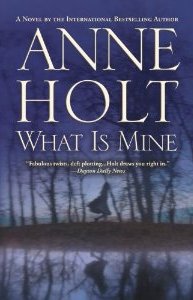
What is Mine by Anne Holt


What is Mine by Norwegian author Anne Holt is the first book about lawyer Johanne Vik and detective Adam Stubo. I have already read the other one, What Never Happens. I grabbed this in my local supermarket for a quick summer read, and I will say that Anne Holt delivers. I finished it in no time and enjoyed the plot and the dialogue and the character development.

A little girl disappears and despite her father's frantic search, she has apparently vanished without a trace. Adam Stubo is on the case, and when more children disappear it becomes clear that a serial abducter is at loose. At the same time Johanne Vik is being summoned to an old sick lady's house, where she is being told an amazing story: the old woman who is dying and used to work in the Norwegian law system has not been able to forget a case from her past, where a man was convicted of killing a young woman. She feels that the case was never solved in a satisfactory manner, and asks Johanne to investigate.

Later, Adam sees Johanne on tv (this is the book in which they actually meet), and goes to see her personally, asking her to help out with the case of the missing children. Johanne has worked with the FBI when she was young, and Adam feels that her insights into behavioural patterns may be a help in his case.

The story is well written - I read it in Danish and do not know how it translates into English, but if you are a mystery lover and like the Scandinavian style, I highly recommend this one. I recommend it more than the number 2 in the series (actually, don't know if it is a series, but at least there are two books) where I found some of the dialogue rather forced. In this one it flows and the plots are well thought out and tight. Great summer read.